

Harris
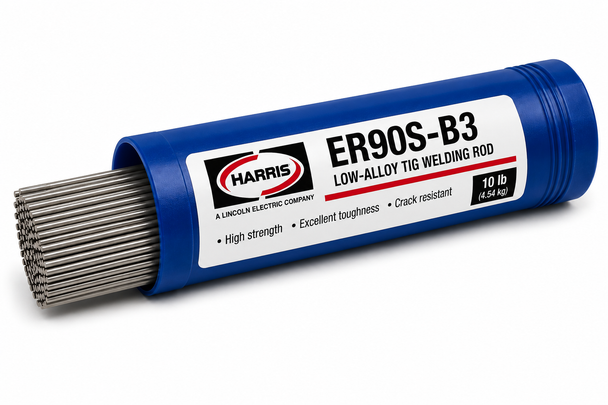
Harris ER90S-B3 Low-Alloy TIG Welding Rod 10 lb
- Availability:
- Usually in Stock – Ships Quickly
- Weight:
- 0.00 LBS




Description
Harris ER90S-B3 Low-Alloy TIG Welding Rod 10 lb
Harris ER90S-B3 TIG (GTAW) welding rod is a chromium-molybdenum low-alloy filler metal designed for welding 2-1/4% chromium / 1% molybdenum steels used in high-temperature and high-pressure service. It is also suitable for joining dissimilar combinations of chromium-molybdenum and carbon steels.
Select the required rod diameter from the product options above. Each variation is supplied in a 10 lb box and determines the Harris part number, online selling price, shipping weight, and net cost.
Product Highlights
- ER90S-B3 low-alloy TIG / GTAW welding rod
- Designed for 2-1/4% chromium / 1% molybdenum steels
- Suitable for high-temperature and high-pressure applications
- Used for high-pressure piping and pressure vessels
- Suitable for joining chromium-molybdenum steels to carbon steels
- Designed for demanding elevated-temperature service
- All-position welding capability with an appropriate qualified procedure
- Conforms to AWS A5.28 / ASME SFA-5.28 ER90S-B3
Technical Specifications
Common Applications
High-Temperature Service
- High-pressure piping
- Pressure vessels
- Power-generation equipment
- Petrochemical processing equipment
Fabrication & Repair
- Cr-Mo steel fabrication
- Cr-Mo to carbon-steel joining
- Boilers and pressure components
- Industrial maintenance and repair
Product Resources
Review current Harris manufacturer information and the applicable qualified welding procedure before final product selection or welding.
Need Help Selecting ER90S-B3 TIG Rod?
Our GetPipe.com team can help confirm rod diameter, base material, filler-metal classification, welding procedure requirements, availability, and related welding supplies.
Frequently Asked Questions
What is Harris ER90S-B3 TIG rod used for?
Harris ER90S-B3 is designed for welding 2-1/4% chromium / 1% molybdenum steels used in high-temperature and high-pressure applications including piping and pressure vessels.
Can ER90S-B3 join chromium-molybdenum steel to carbon steel?
Yes. Harris identifies ER90S-B3 for joining dissimilar combinations of chromium-molybdenum and carbon steels.
What shielding gas is used for TIG welding ER90S-B3?
100% argon is the standard shielding gas for TIG / GTAW welding with ER90S-B3 rod.
What rod sizes are offered in this GetPipe.com listing?
This listing includes 3/32 in., 1/8 in., and 5/32 in. diameters, each supplied in a 10 lb box.
Does ER90S-B3 require heat-control procedures?
Preheat, interpass temperature, and post-weld heat treatment should be controlled according to the qualified welding procedure, base material, and governing code requirements.
Important Ordering & Safety Notes
- Each variation is supplied as 36 in. TIG rod in a 10 lb box.
- Selected diameter determines the Harris part number, online price, shipping weight, and cost.
- Verify base-metal grade, shielding gas, welding procedure, preheat/interpass temperature, post-weld heat treatment, and applicable code requirements before use.
- Welding fumes and gases can be hazardous. Review current manufacturer labeling and safety documentation and follow applicable workplace safety requirements.