

Harris
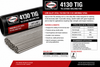
Harris 4130 Chrome-Moly TIG (GTAW) Welding Rod 10 lb

- Availability:
- Usually in Stock – Ships Quickly
- Weight:
- 0.00 LBS



Description
Harris 4130 Chrome-Moly TIG (GTAW) Welding Rod 10 lb
Harris 4130 Chrome-Moly TIG welding rod is a high-strength, low-alloy chromium-molybdenum steel filler rod designed for TIG (GTAW) welding of alloys with similar composition. It is formulated to reduce weld-metal hot cracking while providing good ductility and is particularly well suited for thin, highly stressed joints.
Select the required diameter from the product options above. Both available variations are supplied as 36-inch rods in 10 lb boxes. The selected variation determines the Harris part number, online selling price, shipping weight, and net cost.
Product Highlights
- High-strength, low-alloy chromium-molybdenum steel TIG welding rod
- Designed for welding 4130 and alloys of similar composition
- Formulated to reduce weld-metal hot cracking
- Provides good weld ductility
- Particularly suited for thin, highly stressed joints
- Designed for TIG / GTAW welding applications
- Manufactured to Harris Products Group internal engineering standards
- Rod identification is marked for easier product verification
Technical Specifications
Common Applications
4130 Alloy Fabrication
- 4130 chromium-molybdenum steel
- Alloys of similar composition
- Thin-wall alloy-steel fabrication
- Highly stressed welded joints
High-Strength Welding
- Structural alloy-steel fabrication
- Precision TIG welding
- Fabricated tubing and assemblies
- Applications requiring good ductility and crack resistance
Product Resources
Review current Harris manufacturer information and the applicable welding procedure before final product selection or welding.
Need Help Selecting Harris 4130 TIG Rod?
Our GetPipe.com team can help confirm rod diameter, base material, welding process, availability, and related welding supplies.
Frequently Asked Questions
What is Harris 4130 TIG welding rod used for?
Harris 4130 is designed for TIG welding chromium-molybdenum steels and alloys of similar composition, particularly thin and highly stressed welded joints.
What welding process is used with Harris 4130 rod?
Harris 4130 welding rod is designed for gas tungsten arc welding, commonly called TIG or GTAW.
What diameters are available in this GetPipe.com listing?
This listing includes 1/16 in. (1.6 mm) and 3/32 in. (2.4 mm) diameter rods. Both variations are supplied in 10 lb boxes.
How long are the welding rods?
The Harris 4130 TIG rods included in this listing are supplied in 36-inch lengths.
Does Harris specify preheat for 4130 welding?
Harris product information specifies use of the applicable S.A.E. 4130 heat-treatment procedure and a minimum preheat and interpass temperature of 400°F (204°C). Always follow the applicable welding procedure for the specific base material and application.
Important Ordering & Safety Notes
- Rod length is 36 in.
- Both current GetPipe.com variations are supplied in 10 lb boxes.
- Selected diameter determines the Harris part number, online price, shipping weight, and cost.
- Verify base material, welding process, heat-treatment requirements, and the applicable welding procedure before use.
- Use the appropriate preheat and interpass temperature for the welding procedure and application.
- Welding fumes and gases can be hazardous. Review current manufacturer labeling and safety documentation and follow applicable workplace safety requirements.