
Spears
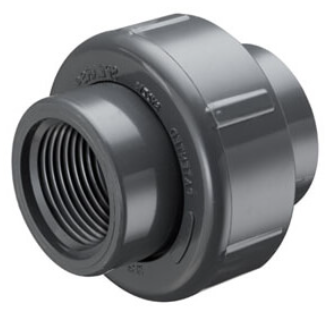
Schedule 80 PVC EPDM Union 2000 (S x S)

- Availability:
- Usually Ships Same Day
- Weight:
- 0.00 LBS



Description
Schedule 80 PVC EPDM Union 2000 (S x S)
Schedule 80 PVC EPDM Union 2000 (S x S) provides a removable connection between compatible Schedule 80 PVC pipe sections while using socket connections at both ends. The Union 2000 configuration creates a serviceable mechanical separation point, while the EPDM sealing element provides the seal within the assembled union joint.
The Socket x Socket configuration combines compatible PVC solvent-cement connections with a removable union assembly that can be opened without cutting the adjoining pipe. Selection should account for nominal size, Schedule 80 PVC compatibility, EPDM seal compatibility, adjoining pipe, intended service conditions, joining materials, piping alignment, maintenance access, and available installation clearance.
Product Highlights
- PVC construction
- EPDM sealing element
- Schedule 80 design
- Union 2000 configuration
- Socket x Socket connections
- Provides a removable piping connection
- Allows separation without cutting adjoining pipe
- Supports serviceable connections in Schedule 80 PVC piping systems
Technical Specifications
| Product Type | Union |
|---|---|
| Material | PVC |
| Schedule | Schedule 80 |
| Union Series | Union 2000 |
| Seal Material | EPDM |
| Connection | Socket (S) x Socket (S) |
| Socket Interface | Compatible PVC Pipe |
| Connection Style | Socket x Socket |
| Pipe Joining Method | Compatible PVC Solvent-Cement Joining |
| Union Joint | Removable Mechanical Connection |
| Service Feature | Union Disassembly Without Cutting Adjoining Pipe |
| Primary Function | Provide a Removable Socket-to-Socket Schedule 80 PVC Connection |
Union 2000 Design
The Union 2000 configuration creates a mechanical separation point within a compatible Schedule 80 PVC piping run. After the socket ends are permanently joined to the adjoining pipe, the union joint can be disassembled independently so connected piping or equipment can be separated without cutting the solvent-cemented pipe sections.
This serviceable arrangement can simplify appropriate maintenance, equipment removal, and piping access where future disconnection is expected. Adequate working space should be maintained around the union so the mechanical joint remains accessible while the adjoining pipe is independently supported during disassembly and reassembly.
EPDM Sealing Element
The EPDM sealing element provides the seal within the removable union joint when the fitting is correctly assembled. Because elastomer suitability depends on the application, EPDM compatibility should be evaluated against the conveyed media, temperature, concentration, and other service conditions expected within the completed piping system.
The EPDM element and its mating sealing surfaces should remain clean, correctly positioned, and free from damage whenever the union is assembled or serviced. Inspection during maintenance helps identify contamination, displacement, wear, or deterioration that could interfere with proper sealing when the union is returned to service.
Socket x Socket Connections
The Socket x Socket configuration provides receiving connections for appropriately sized compatible PVC pipe on both sides of the union. These socket ends allow the fitting to be incorporated directly into a Schedule 80 PVC piping run using compatible PVC solvent-cement joining procedures and materials.
Both pipe ends should be prepared and aligned correctly before the permanent socket joints are completed. Proper insertion and positioning help keep the union centered between the adjoining pipe sections while avoiding unnecessary side loading that could interfere with future operation of the removable mechanical joint.
Serviceable PVC Connection
A Schedule 80 PVC EPDM Union 2000 provides a practical service point where compatible PVC piping may need to be disconnected without disturbing the permanent socket connections. Opening the union joint allows the connected sections to separate while the socket ends remain solvent-cemented to their respective pipe sections.
Application suitability should be evaluated using the requirements of the complete piping system rather than the Schedule 80 designation alone. EPDM compatibility, adjoining PVC pipe, service conditions, joining materials, installation environment, piping support, maintenance access, and applicable installation practices should all be considered during union selection.
Installation & Selection Considerations
- Confirm the nominal size.
- Verify EPDM seal compatibility.
- Check Schedule 80 PVC compatibility.
- Confirm both socket connection requirements.
- Allow adequate access for future union service.
Our PVC fitting specialists can help review your nominal size, Schedule 80 requirements, Socket x Socket connections, EPDM seal compatibility, adjoining PVC pipe, intended service conditions, joining requirements, maintenance access, piping support, and available installation clearance before you order.
Frequently Asked Questions
What is a Schedule 80 PVC EPDM Union 2000 used for?
It provides a removable connection between compatible Schedule 80 PVC pipe sections while retaining permanent socket connections to the adjoining pipe.
What does S x S mean?
S x S means the union provides socket connections at both ends for appropriately sized compatible PVC pipe.
What does EPDM identify?
EPDM identifies the elastomer material used for the sealing element within the removable union joint.
Why use a union instead of a standard coupling?
A union provides a mechanical separation point that can be disassembled, while a conventional solvent-cemented coupling creates a permanent inline connection.
Can the union be separated without cutting the pipe?
Yes. The mechanical union joint can be opened while the socket ends remain permanently joined to their adjoining PVC pipe sections.
How are the socket ends connected?
The compatible PVC pipe and union sockets are prepared and assembled using the appropriate PVC solvent-cement joining procedure.
Important Ordering & Installation Notes
- Inspect sockets before use.
- Keep sealing surfaces clean.
- Prepare both pipe ends correctly.
- Seat the EPDM seal before final assembly.
- Support adjoining piping during union service.