

Milwaukee
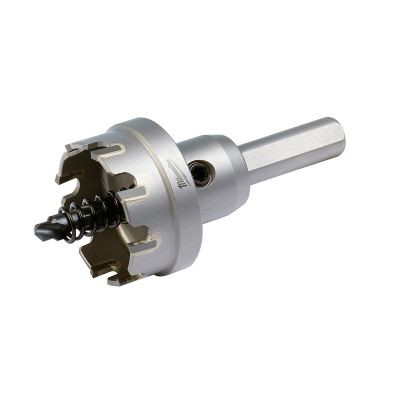
Milwaukee Tool 1-1/8" One-Piece Carbide Hole Cutter

- SKU:
- MLW49-57-8615
- Availability:
- Usually Ships Same Day
- Weight:
- 0.24 LBS


Description

DUTY®
1-1/8" One-Piece
Carbide Hole Cutter
A 1-1/8-inch carbide-tooth cutter for holes in metal sheet up to 3/16 inch thick, using a drill/driver and a spring-loaded pilot.
Product Overview
The stop shoulder limits depth to 3/16 inch; choose a different cutting system for thicker sections.
Check the required finished hole diameter and drill clearance before cutting, including room for the plug.
- Carbide teethCuts the specified metals.
- Depth-limiting stopShoulder sets a depth limit.
- Three-flat shankHelps the chuck grip.
- Spring-loaded pilotClears the cut plug.
Technical Specifications
- Hole diameter
- 1-1/8 in
- Cutting depth
- 3/16 in
- Tooth material
- Carbide
- Shank form
- 3-flat
- Pilot action
- Spring-loaded
- Drive tool
- Drill/driver
Choose the Correct Fit
Choose this diameter for the required finished opening. Check the fitting or hardware dimensions rather than relying on a nominal trade size.
Verify metal thickness is within the 3/16-inch cutting depth. The listed applications include stainless steel, mild steel, copper and aluminum.
Installation & Care
Clamp the material securely and follow the cutter and drill instructions for speed, lubrication and feed. Keep the drill square to the sheet.
Let the cutter stop before clearing chips or the ejected plug. Inspect carbide teeth and the pilot before each use.
Small Details. Big Jobsite Energy.
Get set. Stay focused. Make your next move count.
THE NEXT JOB.

Ask Willy:
Need help choosing? Tell Willy your material, required size and working clearance so the GetPipe team can check the fit.
Important Product Questions
Can it cut material thicker than 3/16 inch?
The stop shoulder limits cutting depth to 3/16 inch. Select a cutter with adequate depth for thicker material instead of forcing this one past its shoulder.
Is it intended for an impact driver?
The specified drive tool is a drill/driver, using the 3-flat shank. Do not treat the shank shape as an impact-duty rating.
Is the hole size the same as a fitting’s trade size?
Not necessarily. Match the actual required opening to the cutter diameter; conduit and other fittings may use nominal sizes that differ from the mounting hole.