

Midland Industries
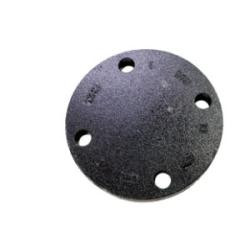
Midland Black Ductile Iron Blind Flange
- Availability:
- Allow 2-3 Days to Ship
- Weight:
- 0.00 LBS




Description
Midland Ductile Iron 150 lb Blind Flange
Midland Ductile Iron 150 lb Blind Flanges provide a secure way to close off the end of compatible Class 150 flanged piping systems.
Manufactured from durable ductile iron with a black protective finish, these blind flanges are drilled to ASME Class 150 bolt patterns for use with compatible raised-face flange connections. Available in nominal sizes from 2" through 8", they are well suited for commercial, industrial, and municipal piping applications requiring a removable end closure.
Product Highlights
- Midland ductile iron blind flange
- Class 150 pressure class
- High-strength ductile iron construction
- Black protective finish
- Blind design seals the end of a flanged piping system
- ASME Class 150 bolt pattern
- Compatible with raised-face flange connections
- Precision-machined sealing surface
- Accurately drilled bolt holes for proper alignment
- Available in 2", 2-1/2", 3", 4", 5", 6", and 8" nominal sizes
- Suitable for commercial, industrial, and municipal piping systems
Technical Specifications
| Product Type | Blind Flange |
|---|---|
| Brand | Midland |
| Material | Ductile Iron |
| Pressure Class | Class 150 |
| Finish | Black Protective Coating |
| Flange Style | Blind |
| Bolt Pattern | ASME Class 150 |
| Face Compatibility | Raised Face Flange Connections |
| Available Sizes | 2", 2-1/2", 3", 4", 5", 6", and 8" |
| Primary Function | End-of-Line Flanged Piping Closure |
| Typical Applications | Commercial, Industrial, and Municipal Piping Systems |
| Gasket & Hardware | Sold Separately |
Flange Configuration
Solid Blind Face
The solid center section closes the end of a compatible flanged piping connection without adding another outlet or flow path.
Machined Sealing Surface
The machined flange face provides the mating surface needed for proper gasket compression and sealing.
Class 150 Bolt Pattern
Accurately drilled bolt holes provide compatibility with corresponding ASME Class 150 flange assemblies.
Construction Details
The Midland blind flange is manufactured from ductile iron for improved strength, toughness, and impact resistance compared with traditional gray iron components.
Precision-machined sealing surfaces and accurately located bolt holes help support proper alignment and dependable gasket compression when installed with compatible flange hardware.
A black protective coating helps protect the flange during storage, handling, and installation.
Why Use a Blind Flange?
Secure End Closure
- Closes off a flanged pipe end
- Provides a bolted, removable connection
- Useful for future system access
- Suitable for isolation points
- Can be removed for inspection or system expansion
Serviceable Connection
- Bolted flange assembly
- No permanent welded cap required
- Allows future piping modification
- Convenient for maintenance access
- Uses standard gasket and bolting practices
Ductile Iron Construction
Strength & Toughness
Ductile iron provides strong mechanical properties and improved toughness for demanding piping applications.
Durable Service
The robust construction makes the flange suitable for compatible commercial, industrial, and municipal piping environments.
Typical Applications
Commercial & Mechanical Systems
- Building utility piping
- Mechanical room systems
- Equipment isolation points
- General flanged piping
- System maintenance access points
Industrial & Municipal Systems
- Municipal water piping
- Industrial utility systems
- Plant piping
- Flanged equipment connections
- Pipeline termination points
Blind Flange vs. Flanged Cap
Blind Flange
A blind flange is a solid flange that bolts directly to a mating flange and closes the piping opening without a bore.
Flanged Cap
A flanged cap performs a similar end-closure function but may use a different body shape or dimensional configuration depending on the piping system.
Frequently Asked Questions
What is a blind flange used for?
A blind flange is used to close the end of a flanged piping system while maintaining a removable bolted connection.
What material is this flange made from?
The supplied product information identifies ductile iron construction.
What pressure class is this flange?
The supplied product information identifies a Class 150 flange.
What bolt pattern does it use?
The supplied product information identifies an ASME Class 150 bolt pattern.
What sizes are available?
The supplied product information lists 2", 2-1/2", 3", 4", 5", 6", and 8" nominal sizes.
What finish is applied?
The supplied product information identifies a black protective finish.
Is a gasket included?
No. The supplied product information states that the gasket is sold separately.
Are bolts, nuts, and washers included?
No. The supplied product information states that flange hardware is sold separately.
Can the flange be removed later?
Yes. Because it is installed as a bolted flange connection, it can be removed for compatible system inspection, maintenance, or modification after the system has been safely depressurized.
What should I verify before ordering?
Confirm nominal flange size, ASME Class 150 bolt pattern, face configuration, gasket requirements, pressure requirements, and mating flange compatibility before ordering.
Important Ordering & Installation Notes
- This listing is for Midland Ductile Iron 150 lb Blind Flanges.
- Available nominal sizes are 2", 2-1/2", 3", 4", 5", 6", and 8".
- Confirm the required nominal flange size before ordering.
- Verify ASME Class 150 bolt-pattern compatibility with the mating flange.
- Confirm raised-face compatibility with the intended flange connection.
- Gasket, bolts, nuts, and washers are sold separately.
- Select a gasket suitable for the flange faces, media, pressure, and operating temperature.
- Use bolting compatible with the flange dimensions and system requirements.
- Ensure mating flange faces are clean and properly aligned before assembly.
- Do not use flange bolts to force severely misaligned piping into position.
- Tighten bolts using the appropriate cross-pattern sequence to achieve even gasket compression.
- Follow applicable flange, gasket, and hardware torque requirements.
- Depressurize and drain the piping system before removing an installed blind flange.
- Verify system pressure requirements before placing the connection into service.
- Install according to applicable piping standards, project requirements, and manufacturer recommendations.