

Service Metal
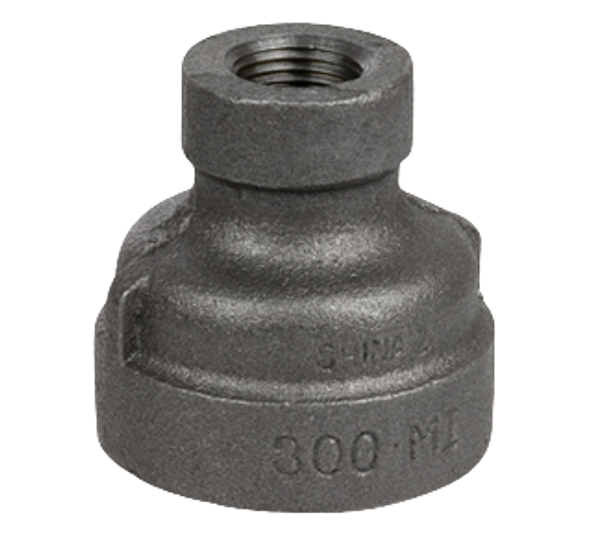
300# Black Malleable Couplings

- SKU:
- XBCPL
- Availability:
- Usually Ships Same Day
- Weight:
- 0.00 LBS



Description
300# Black Malleable Iron Coupling
300# Black Malleable Iron Couplings are designed to join two male-threaded pipes in a straight run while providing a strong, compact connection for higher-duty threaded piping systems.
Manufactured from durable malleable iron, these Class 300 couplings are well suited for industrial, commercial, plumbing, mechanical, gas, air, oil, and compatible fluid piping applications where dependable threaded connections are required.
Product Highlights
- Straight threaded coupling configuration
- Female NPT x female NPT connection
- Designed to join two matching male-threaded pipes
- Maintains a straight piping run
- Compact fitting design
- Designed for higher-duty Class 300 threaded piping systems
- Durable black malleable iron construction
- Malleable castings conform to ASTM A197
- Malleable fitting dimensions conform to ASME B16.3
- NPT threads conform to ASME B1.20.1
- Class 300 fittings are UL Listed
- Suitable for gas, oil, air, and compatible fluid piping systems
- Manufactured in an ISO-certified facility
- Country of origin: Thailand & China
Technical Specifications
| Product Type | Coupling |
|---|---|
| Material | Malleable Iron |
| Finish | Black |
| Pressure Class | 300# |
| Connection Type | Female NPT x Female NPT |
| Configuration | Straight Coupling |
| Primary Function | Join Two Threaded Pipes in a Straight Run |
| Casting Standard | ASTM A197 |
| Dimensional Standard | ASME B16.3 |
| Thread Standard | ASME B1.20.1 |
| Listing | Class 300 Fittings are UL Listed |
| Manufacturing | ISO-Certified Facility |
| Country of Origin | Thailand & China |
Construction & Applications
Malleable Iron Construction
Manufactured from malleable iron castings conforming to ASTM A197 for dependable strength and durability in demanding threaded piping systems.
Straight Pipe Connection
The female-threaded coupling joins two compatible male-threaded pipe ends while maintaining the alignment of a straight piping run.
Class 300 Design
The heavier Class 300 construction is intended for more demanding threaded piping applications than standard Class 150 malleable iron fittings.
Why Use a Threaded Coupling?
Simple Pipe Extension
A coupling provides a straightforward way to join two threaded pipe sections of the same nominal size and extend a straight piping run.
Compact Connection
The fitting creates a short, in-line connection without changing pipe direction, making it useful where installation space is limited.
Typical Applications
Industrial & Mechanical Piping
- Industrial piping systems
- Mechanical piping
- Compressed air systems
- Equipment piping
- General fluid piping
Common Service Applications
- Gas piping
- Oil piping
- Air lines
- Utility piping
- Higher-duty threaded systems

Ask Willy: Need Pipe Size Help?
Use our common pipe diameters and wall thickness chart to confirm sizing before ordering 300# black malleable iron fittings. You can also review the coupling specification sheet and Certificate of Conformance below.
Standards & Approvals
ASTM A197
Malleable iron castings conform to ASTM A197.
ASME Standards
Malleable fitting dimensions conform to ASME B16.3, while NPT threads conform to ASME B1.20.1.
UL Listing
The supplied product information states that Class 300 malleable iron fittings are UL Listed.
Related Malleable Iron Standards
- Malleable bushings, plugs, and locknuts conform to ASME B16.14.
- Malleable unions conform to ASME B16.39.
- NPT threads on applicable fittings conform to ASME B1.20.1.
- Class 300 fittings are UL Listed according to the supplied product information.
Need More 300# Black Malleable Iron Fittings?
Browse our complete selection of 300# black malleable iron fittings, including couplings, elbows, street elbows, tees, bushings, unions, and other heavy-duty threaded fittings.
Frequently Asked Questions
What is a 300# black malleable iron coupling used for?
It is used to connect two compatible male-threaded pipes of the same nominal size in a straight piping run.
What type of connections does this coupling use?
The coupling uses female NPT threaded connections on both ends.
Does a standard coupling reduce pipe size?
No. This standard coupling is intended to connect matching nominal pipe sizes. Use a reducing coupling or other reducing fitting when a change in pipe size is required.
How is a coupling different from a union?
A coupling provides a conventional threaded connection between two pipes. A union is designed with a separable center connection so piping can be disconnected more easily for maintenance.
How is a 300# coupling different from a 150# coupling?
The Class 300 coupling is a heavier-duty fitting intended for more demanding threaded piping applications than a standard Class 150 fitting.
What material standard applies?
The supplied product information states that the malleable iron castings conform to ASTM A197.
What dimensional standard applies?
Malleable fitting dimensions conform to ASME B16.3.
What thread standard applies?
NPT threads conform to ASME B1.20.1.
Are Class 300 malleable iron fittings UL Listed?
Yes. The supplied product information states that Class 300 fittings are UL Listed.
What should I verify before ordering?
Confirm the nominal pipe size, female NPT connection type, required fitting class, service conditions, and applicable piping-system requirements.
Important Ordering & Installation Notes
- Confirm the required nominal pipe size before ordering.
- This fitting uses female NPT threaded connections on both ends.
- The standard coupling is intended to connect matching nominal pipe sizes.
- Use a reducing coupling if a change in pipe size is required.
- Confirm that Class 300 construction is appropriate for the intended piping system.
- NPT threads conform to ASME B1.20.1.
- Malleable fitting dimensions conform to ASME B16.3.
- Use compatible pipe, fittings, thread sealant, and accepted threaded installation practices.
- Do not assume the “300#” class designation alone establishes allowable working pressure for every service condition.
- Verify pressure, temperature, media compatibility, applicable codes, and system requirements before installation.
- Refer to the specification sheet and Certificate of Conformance for additional product information.