
Merit Brass
125# Leaded Brass 45° Elbow
- SKU:
- X102
- Availability:
- Usually Ships Same Day
- Weight:
- 0.00 LBS
Description
125# Leaded Brass 45° Elbow
125# Leaded Brass 45° Elbows are threaded fittings designed to change the direction of compatible piping by 45 degrees. The shallower angle provides a smoother directional transition than a 90-degree elbow and is useful for offsets, routing changes, and compact piping layouts.
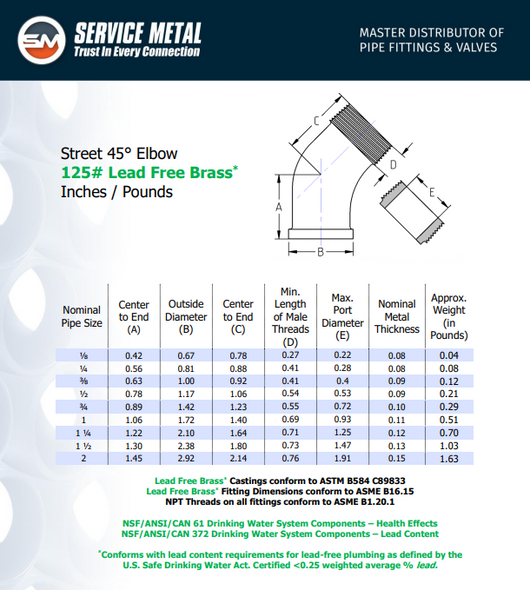
This product is identified as a 125# leaded brass fitting. Manufacturer dimensional, certification, and material safety documentation is provided below for reference.
Product Highlights
- 125# brass 45° elbow
- Leaded brass construction
- 45-degree directional change
- Threaded fitting configuration
- Provides a shallower turn than a 90° elbow
- Useful for piping offsets and directional transitions
- Compact brass fitting design
- Suitable for compatible plumbing and mechanical applications
- Manufacturer fitting dimensions available
- Manufacturer certification letter available
- Material Safety Data Sheet available
Technical Specifications
| Product Type | 45° Elbow |
|---|---|
| Pressure Class | 125# |
| Material | Brass |
| Lead Status | Leaded |
| Connection Type | Threaded |
| Angle | 45° |
| Primary Function | Changing Piping Direction by 45 Degrees |
| Product Documentation | Dimensions, Certification Letter, and SDS Available |
45° Elbow Construction
A 45° elbow is used to redirect a compatible threaded piping run through a 45-degree turn. This provides a more gradual change in direction than a 90-degree elbow.
The fitting is useful for offsets and routing adjustments where a full right-angle turn is not required.
The threaded configuration allows connection to compatible threaded pipe, nipples, fittings, valves, or equipment.
Why Choose a 45° Elbow?
Gradual Direction Change
- Changes piping direction by 45 degrees
- Useful for angled offsets
- Provides a shallower turn than a 90° elbow
- Helps route piping around obstructions
- Suitable for compact piping layouts
Threaded Brass Construction
- Brass fitting body
- Leaded material
- Threaded connection configuration
- Suitable for compatible piping applications
- Manufacturer documentation provided below
45° Elbow vs. 90° Elbow
45° Elbow
- Provides a shallower directional change
- Changes piping direction by 45 degrees
- Useful for offsets and gradual routing changes
- Can be used in pairs to create offset piping arrangements
- This product configuration
90° Elbow
- Provides a right-angle turn
- Changes piping direction by 90 degrees
- Useful where a sharper turn is required
- Common in tight piping layouts
- Different angle from this fitting
Common Applications
Plumbing & Mechanical Piping
- Threaded piping systems
- Pipe routing adjustments
- Offset piping arrangements
- Equipment connections
- General plumbing assemblies
Industrial & General Service
- Mechanical piping installations
- Maintenance and repair work
- Compatible process piping
- Utility piping
- Applications requiring a brass threaded 45° elbow
Installation & Selection Guidance
- Confirm the required nominal fitting size before ordering.
- Verify thread compatibility with the mating piping components.
- Confirm the 45-degree configuration matches the intended piping layout.
- Use an appropriate thread sealant for the system media, pressure, and temperature.
- Apply thread sealant according to the sealant manufacturer's instructions.
- Use appropriate wrenching surfaces during installation.
- Avoid over-tightening threaded fittings.
- Confirm pressure, temperature, and media compatibility before use.
- Verify that leaded brass is permitted for the intended application.
- Installation should comply with applicable piping, plumbing, and project requirements.
Important Material Notice
- This product is identified as leaded brass.
- Confirm that leaded fittings are permitted for the intended application before installation.
- Do not assume this product meets lead-free potable-water requirements.
- Review the manufacturer certification and material safety documentation for additional information.
Product Documents
Import Brass Leaded Fitting Dimensions
Review manufacturer dimensional information for applicable leaded brass fittings and connection sizes.
Import Brass Leaded Fitting Certification Letter
Review manufacturer certification documentation for the import leaded brass fitting product line.
Material Safety Data Sheet
Review the supplied material safety documentation for the leaded brass fitting product line.
Need Help Selecting a 125# Leaded Brass 45° Elbow?
Our industrial PVF specialists can help review your fitting size, thread requirements, piping layout, and material requirements before you order.
Frequently Asked Questions
What is a 45° elbow used for?
A 45° elbow is used to change the direction of a compatible piping run by 45 degrees.
How is a 45° elbow different from a 90° elbow?
A 45° elbow provides a shallower directional change, while a 90° elbow creates a full right-angle turn.
Can two 45° elbows be used to create an offset?
Yes. In compatible piping layouts, two 45° elbows can be used to create an offset or directional transition.
What material is this fitting?
The supplied product information identifies this fitting as leaded brass.
What pressure class is this fitting?
The product is identified as a 125# fitting.
Is this fitting lead free?
No. The supplied product information identifies this fitting as leaded.
Where can I find fitting dimensions?
Use the Import Brass Leaded Fitting Dimensions document in the Product Documents section above.
Where can I find certification information?
Use the Import Brass Leaded Fitting Certification Letter in the Product Documents section above.
Is an SDS available?
Yes. A Material Safety Data Sheet is provided in the Product Documents section above.
Important Ordering Notes
- Product is a 125# leaded brass 45° elbow.
- Threaded fitting configuration.
- Designed to change piping direction by 45 degrees.
- Leaded brass construction.
- Confirm nominal fitting size before ordering.
- Verify thread compatibility with mating piping components.
- Confirm pressure, temperature, and media compatibility before use.
- Verify that leaded material is permitted for the intended application.
- Refer to the manufacturer dimensional, certification, and SDS documents for additional product information.