

Spears
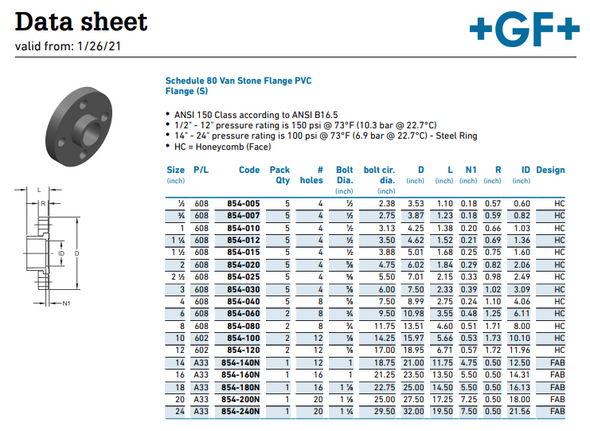
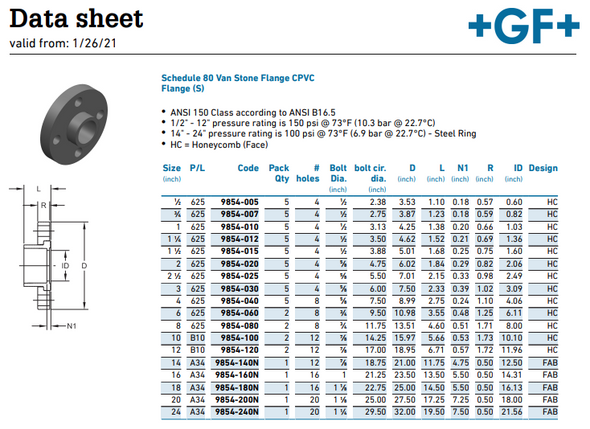
Schedule 80 Van Stone Flange (Flange x PIP Socket)

- Availability:
- Usually Ships Same Day
- Weight:
- 0.00 LBS




Description
Schedule 80 Van Stone Flange (Flange x PIP Socket)
Schedule 80 Van Stone Flange (Flange x PIP Socket) provides a detachable flanged transition for compatible Schedule 80 thermoplastic piping where a PIP socket connection is required on the pipe side. The Van Stone configuration allows the flange ring to rotate independently, helping simplify bolt-hole alignment with the adjoining flanged component during installation.
The Flange x PIP Socket configuration combines a bolted flange connection with a socket designed for compatible PIP-size piping. This configuration is useful where a PIP piping run must terminate at a removable flange connection, with selection based on the required PIP size, mating flange compatibility, gasket requirements, system conditions, and available installation clearance.
Product Highlights
- Schedule 80 design
- PIP socket connection
- Van Stone flange style
- Rotating flange ring design
- Flange x PIP socket configuration
- Provides a detachable piping connection
- Simplifies mating flange bolt-hole alignment
- Transitions compatible PIP piping to a flanged connection
Technical Specifications
| Product Type | Van Stone Flange |
|---|---|
| Schedule | Schedule 80 |
| Connection | Flange x PIP Socket |
| Flange Style | Van Stone |
| Pipe Connection | PIP Socket |
| Pipe Sizing System | PIP |
| Ring Configuration | Rotating Flange Ring |
| Pipe-Side Joint | Socket Connection |
| Flange-Side Joint | Gasketed Bolted Connection |
| Connection Function | Detachable Flanged Transition |
| Primary Function | Connect Compatible PIP Piping to a Flanged Component |
Van Stone Flange Configuration
The Van Stone flange configuration uses a rotating flange ring that allows the bolt-hole orientation to be adjusted independently of the connected piping. This provides installation flexibility when matching the fitting to a compatible valve, equipment connection, fitting, or other flanged component.
The rotating arrangement is particularly useful after the pipe-side connection has been positioned because final bolt alignment can be completed without changing the orientation of the connected piping. The flange ring can be rotated into position before the gasket and required fasteners are installed.
PIP Socket Connection
The PIP socket connection is intended for compatible piping manufactured to the corresponding PIP sizing system. Because PIP sizing is distinct from other common thermoplastic pipe sizing systems, the pipe dimensions and fitting socket must be matched correctly before the flange is ordered or installed.
The adjoining pipe should be properly prepared and inserted according to the applicable joining procedure for the piping material and system. Confirming the PIP connection before assembly helps prevent selecting a socket intended for a different pipe outside-diameter convention.
Detachable Flange Connection
The flanged connection creates a detachable mechanical joint with a compatible mating flange. A suitable gasket is positioned between the flange faces, while the appropriate fasteners secure the assembly and allow the connection to be separated later when maintenance or component replacement is required.
The mating flange should align naturally with the Van Stone ring before tightening begins. Proper piping support and flange alignment help prevent unnecessary mechanical stress from being transferred into the fitting, gasket, fasteners, or adjoining system components.
PIP System Connection Planning
A Flange x PIP Socket configuration provides a transition point where compatible PIP piping must connect to a removable flanged component. This can provide convenient access around valves, equipment, or other locations where future separation of the piping connection may be necessary.
Installation planning should consider the PIP pipe size, socket engagement, mating flange dimensions, gasket placement, bolt access, and surrounding equipment clearance. Reviewing these requirements before assembly helps establish a properly aligned and accessible flange connection.
Installation & Selection Considerations
- Confirm the PIP size.
- Verify Schedule 80 requirements.
- Match the PIP socket dimensions.
- Confirm mating flange compatibility.
- Allow clearance for flange assembly tools.

Our fitting specialists can help review your PIP pipe size, Schedule 80 requirements, PIP socket connection, Van Stone flange configuration, mating flange compatibility, gasket requirements, bolt alignment, and available installation clearance before you order.
Frequently Asked Questions
What is this Schedule 80 Van Stone Flange used for?
It provides a detachable transition between compatible PIP piping and a mating flanged component.
What does Flange x PIP Socket mean?
One side provides the Van Stone flange connection, while the pipe side provides a socket intended for compatible PIP-size piping.
What is a Van Stone flange?
A Van Stone flange uses a rotating flange ring that allows the bolt-hole orientation to be adjusted independently of the connected piping.
What does PIP identify?
PIP identifies the pipe sizing system associated with the socket connection and should be matched to compatible PIP pipe dimensions.
Why is the rotating flange ring useful?
The rotating ring simplifies bolt-hole alignment with the mating flange without requiring the connected piping to be turned.
Is a gasket used at the flange connection?
A compatible flange gasket is typically positioned between the mating flange faces as part of the completed bolted connection.
Should flange bolts correct piping misalignment?
No. The piping and mating flange should be properly positioned before tightening rather than using the bolts to force the components into alignment.
What should I confirm before ordering?
Confirm the PIP size, Schedule 80 requirement, socket compatibility, mating flange configuration, gasket requirements, and available installation clearance.
Important Ordering & Installation Notes
- Inspect the socket before use.
- Center the gasket before bolting.
- Prepare the PIP pipe end correctly.
- Align flange faces before tightening.
- Tighten flange fasteners evenly in sequence.