

Cello
Domestic Wrot Copper x Copper 90° Elbow

- Availability:
- Usually in Stock – Ships Quickly
- Weight:
- 0.00 LBS




Description
Domestic Wrot Copper x Copper 90° Elbow
Domestic wrot copper x copper 90-degree elbows provide a right-angle change in direction between two equal-size copper-tube runs. The two female copper sweat sockets accept properly sized copper tube for soldered residential, commercial, plumbing, mechanical, heating, cooling, maintenance, and repair installations.
Select the required nominal copper tube size from the product options above. The selected variation determines the Cello item number, online selling price, shipping weight, cost, and other size-specific product information.
Product Highlights
- Domestic wrot copper construction
- Copper sweat x copper sweat connections
- Provides a 90-degree change in piping direction
- Equal-size connections on both ends
- Short-radius elbow configuration
- Designed for soldered copper pressure-piping systems
- Available in nominal sizes from 1/8" through 8"
- Suitable for plumbing, mechanical, HVAC, maintenance, and repair applications
Technical Specifications
| Material | Wrot Copper |
|---|---|
| Product Type | Domestic Copper Pressure Fitting |
| Connection | Copper Sweat x Copper Sweat |
| Connection Sizes | Two Equal-Size Connections |
| Directional Change | 90 Degrees |
| Radius | Short Radius |
| Installation Method | Solder Joint or Approved Brazed Joint, as Required |
| Fitting Type | Copper 90° Elbow |
| Applicable Standard | ASME B16.22 |
| Manufacturer | Cello Products |
| Available Sizes | 1/8", 1/4", 3/8", 1/2", 5/8", 3/4", 1", 1-1/4", 1-1/2", 2", 2-1/2", 3", 3-1/2", 4", 5", 6", and 8" |
How a Copper 90° Elbow Works
Each female copper sweat socket fits over properly sized copper tube. After both tube ends and fitting sockets are cleaned and prepared, the joints are assembled with approved flux and soldered or brazed to create a permanent right-angle directional change.
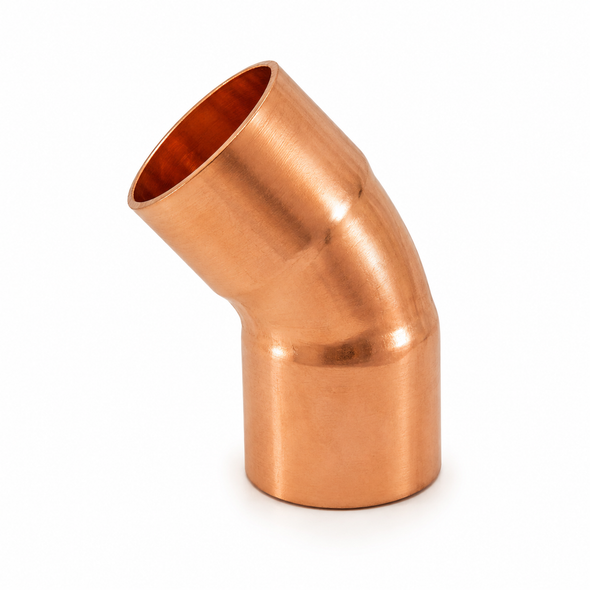
90° Elbow vs. 45° Elbow
90° Elbow
- Changes direction by 90 degrees
- Creates a right-angle turn
- Commonly used at corners
- Useful for horizontal-to-vertical transitions
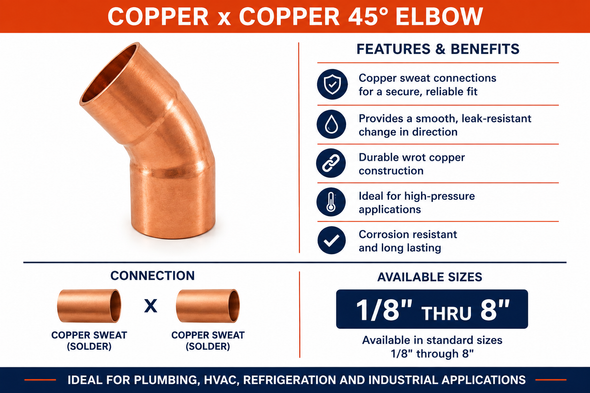
45° Elbow
- Changes direction by 45 degrees
- Creates a more gradual offset
- Useful for angled piping runs
- Produces a less severe directional change
Common Applications
Plumbing and Mechanical Systems
- Potable-water piping
- Residential plumbing systems
- Commercial plumbing installations
- Mechanical-room piping
- Heating-system piping
- Copper distribution piping
HVAC and Equipment Connections
- Air-conditioning piping
- Refrigeration systems
- Heat-pump installations
- Equipment connections
- Vertical and horizontal transitions
- Maintenance and retrofit work
Installation Guidance
- Confirm the required nominal copper tube size before installation.
- Clean and prepare both copper tube ends and fitting sockets properly.
- Use approved flux, solder, brazing alloy, and joining procedures for the application.
- Insert each tube fully into the fitting socket before joining.
- Align the piping correctly before heating the joints.
- Protect nearby valves, seals, insulation, and equipment from excessive heat.
- Support connected piping to avoid mechanical strain on the elbow.
- Pressure-test and inspect completed joints before placing the system into service.
Product Resources
Review the Cello product catalog and NSF Annex G listing before ordering or installation.
Need Help Selecting a Copper 90° Elbow?
Our industrial PVF specialists can help confirm the required copper tube size, bend angle, joining method, material compatibility, application requirements, and product availability.
Frequently Asked Questions
What is a copper 90-degree elbow used for?
It changes the direction of an equal-size copper-tube run by 90 degrees, creating a right-angle turn.
Are both connections the same size?
Yes. This product has equal-size female copper sweat sockets on both ends.
Does the elbow fit over copper tube?
Yes. Both female sweat sockets fit over properly sized copper tube.
Is this a short-radius elbow?
Yes. The WP7 series is a short-radius copper x copper 90-degree elbow.
How is this different from a 45-degree elbow?
A 90-degree elbow creates a right-angle turn. A 45-degree elbow creates a more gradual angled change in direction.
How is the elbow installed?
The copper tube ends and fitting sockets are cleaned, prepared with approved flux, assembled, and soldered or brazed according to accepted procedures and applicable codes.
Is this a domestic copper fitting?
Yes. This product is listed as a domestic wrot copper pressure fitting.
Who manufactures this elbow?
This product is manufactured by Cello Products.
Can it be used in potable-water systems?
It may be used in compatible potable-water systems when installed according to applicable codes, standards, manufacturer requirements, and approved joining procedures.
Can it be used for refrigeration or HVAC piping?
It may be used in compatible HVAC and refrigeration systems when the material, size, joining procedure, pressure, temperature, and system requirements are appropriate.
Is this the same as a street elbow?
No. This copper x copper elbow has two female sweat sockets. A street elbow has one male fitting end and one female copper sweat socket.
Important Ordering Notes
- Select the required nominal copper tube size before adding the product to your cart.
- The selected variation determines the Cello item number, price, shipping weight, and cost.
- Both copper sweat connections are the same nominal size.
- This elbow changes piping direction by 90 degrees.
- This is not a fitting x copper street elbow.
- Confirm the copper tube size before ordering.
- Use approved solder, flux, brazing materials, preparation methods, and installation procedures.
- Insert both copper tubes fully into the fitting sockets before joining.
- Protect valves, seals, insulation, and equipment from excessive heat.
- Support connected piping to avoid excessive stress on the elbow.
- Confirm pressure, temperature, media compatibility, and applicable code requirements before installation.
- Pressure-test and inspect completed joints before placing the system into service.
- Installation should be completed by qualified personnel.