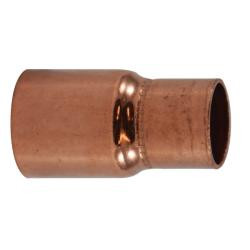


Charman Inc.
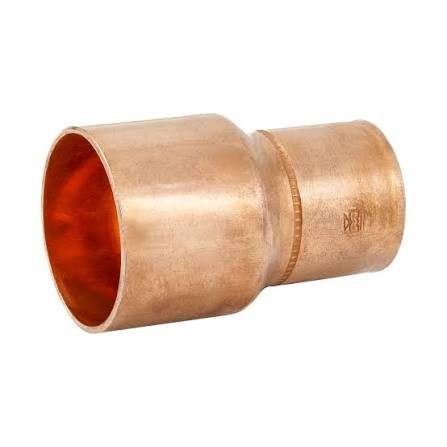
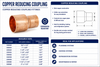
Copper Reducing Coupling - C x C
- Availability:
- Usually in Stock – Ships Quickly
- Weight:
- 0.00 LBS



Description
Copper Reducing Coupling - C x C
Charman Inc. Copper Reducing Couplings provide a straight transition between two different nominal copper tube sizes. The C x C configuration uses cup-style connections on both ends to receive compatible copper tubing for solder / sweat installation.
By combining the straight connection and size reduction into one fitting, a reducing coupling provides a compact way to transition between different tube sizes without changing the direction of the piping run.
Product Highlights
- Copper reducing coupling
- C x C cup-style connections
- Connects two different nominal copper tube sizes
- Copper construction
- Solder / sweat installation
- Creates a straight size transition
- Receives compatible copper tubing at both ends
- Compact alternative to multi-fitting reducing assemblies
Sizes & Part Numbers
| Part Number | Size | UPC |
|---|---|---|
| 330549 | 3/4" x 1/2" | 847877025107 |
| 330553 | 1" x 3/4" | 847877025114 |
| 330554 | 1-1/4" x 1/2" | 847877025121 |
| 330555 | 1-1/4" x 3/4" | 847877025138 |
| 330556 | 1-1/4" x 1" | 847877025145 |
| 330558 | 1-1/2" x 3/4" | 847877025152 |
| 330559 | 1-1/2" x 1" | 847877046249 |
| 330560 | 1-1/2" x 1-1/4" | 847877046256 |
| 330565 | 2" x 1-1/2" | 847877048588 |
Technical Specifications
| Brand | Charman Inc. |
|---|---|
| Product Type | Copper Reducing Coupling |
| Material | Copper |
| Connection Type | C x C |
| Connection Style | Cup / Sweat |
| Joining Method | Solder Joint |
| Configuration | Straight Reducing Coupling |
| Function | Transitions Between Different Copper Tube Sizes |
What Is a Copper Reducing Coupling?
A copper reducing coupling joins two compatible copper tube sections of different nominal sizes in a straight line. Instead of using separate fittings to make the size transition, the reducing coupling combines both tube connections and the reduction into a single fitting.
- Transitions between two different copper tube sizes
- Maintains a straight piping run
- Uses cup-style connections on both ends
- Receives compatible copper tubing at each connection
- Designed for solder / sweat joining
Understanding Reducing Coupling Sizes
Reducing coupling sizes are identified by the two nominal copper tube sizes being connected. The first dimension identifies the larger connection and the second dimension identifies the smaller connection. Both sides use cup-style connections designed to receive compatible copper tubing.
Reducing Coupling vs. Fitting Reducer
C x C Reducing Coupling
Uses cup-style connections on both ends and receives compatible copper tubing at each side. It is designed to transition directly between two different tube sizes in a straight piping run.
FTG x C Fitting Reducer
Uses a fitting-size end that inserts into a compatible copper fitting cup and a cup connection that receives copper tubing. It is useful when the size transition needs to occur directly at another fitting.
Why Use a Reducing Coupling?
Change Tube Size
Transitions between two different nominal copper tube sizes without changing the direction of the piping run.
Compact Installation
Combines the straight connection and size reduction into one fitting for a concise piping layout.
Tube-to-Tube Connection
Both cup ends receive compatible copper tubing for conventional solder / sweat joining.
Common Applications
Plumbing & Mechanical
- Copper water piping
- Mechanical piping systems
- Equipment connections
- Piping modifications
- Repair and maintenance
- Copper tube extensions
Size Transitions
- Reducing copper tube runs
- Equipment room piping
- Branch piping transitions
- Fabricated copper assemblies
- Retrofit piping
- Compact reducing connections
How to Select the Correct Reducing Coupling
- Identify the larger nominal copper tube size.
- Identify the smaller nominal copper tube size.
- Confirm that the piping must remain in a straight line through the transition.
- Verify that cup-style connections are required on both ends.
- Confirm that a C x C reducing coupling is appropriate rather than an FTG x C fitting reducer.
Installation Guidance
- Verify both nominal copper tube sizes before installation.
- Confirm the larger and smaller sides are oriented correctly in the piping layout.
- Cut compatible copper tubing squarely.
- Remove internal and external burrs as appropriate.
- Clean the tubing and fitting cups before soldering.
- Apply appropriate flux according to the joining procedure.
- Fully seat each copper tube into the corresponding side of the coupling.
- Confirm both tube sections are properly aligned before soldering.
- Use proper soldering and heating procedures for copper joints.
- Allow completed joints to cool before disturbing the assembly.
- Test the completed piping system for leakage before placing it into service.

Our pipe and fitting specialists can help review your larger and smaller copper tube sizes, reducing configuration, solder-joint requirements, piping layout, and application before you order.
Email the GetPipe.com Team Visit Quick SupportFrequently Asked Questions
What is a copper reducing coupling?
A copper reducing coupling joins two different nominal copper tube sizes while maintaining a straight piping run.
What does C x C mean?
C x C indicates cup-style connections on both ends designed to receive compatible copper tubing for solder / sweat installation.
How do I read the reducing coupling size?
The first dimension identifies the larger nominal copper tube connection and the second dimension identifies the smaller nominal connection.
How is a reducing coupling different from a standard coupling?
A standard coupling connects equal-size copper tubing, while a reducing coupling connects two different nominal tube sizes.
How is a reducing coupling different from a fitting reducer?
A reducing coupling has cup connections that receive copper tubing at both ends. An FTG x C fitting reducer has one fitting-size end designed to insert into another compatible copper fitting.
Does a reducing coupling change the direction of the piping?
No. It creates a straight transition between different nominal copper tube sizes without changing the direction of the piping run.
Important Ordering Notes
- Verify both nominal copper tube sizes before ordering.
- Confirm the direction of the size transition required by the piping layout.
- Verify that C x C cup-style solder / sweat connections are required.
- Confirm that a straight reducing coupling is appropriate rather than an FTG x C fitting reducer.