

Merit Brass
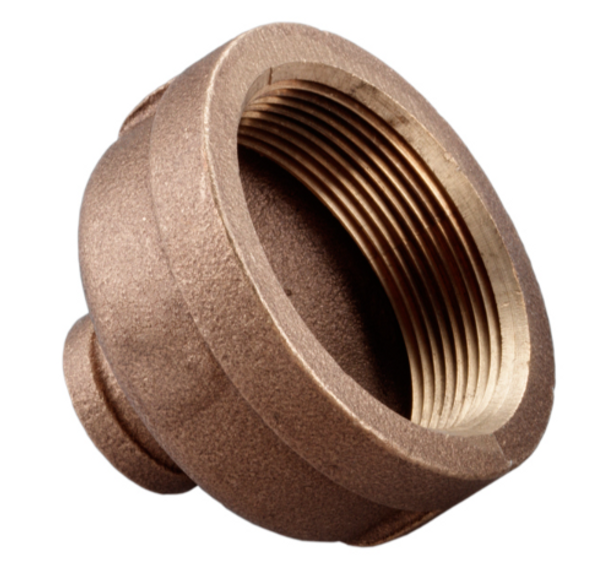
125# Lead Free Brass Reducing Coupling
- SKU:
- XNL112
- Availability:
- Usually Ships Same Day
- Weight:
- 0.00 LBS
Description
125# Lead Free Brass Reducing Coupling
125# Lead Free Brass Reducing Couplings are threaded fittings designed to connect two different nominal pipe sizes in a straight piping run. The reducing configuration combines a coupling and size transition in one fitting, helping simplify installations where a smaller threaded line must connect to a larger one.
These fittings conform with the lead-content requirements for lead-free plumbing as defined by the U.S. Safe Drinking Water Act and are certified to contain ≤0.25 weighted average % lead. Manufacturer dimensional, certification, and material safety documentation is provided below.
Product Highlights
- 125# lead free brass reducing coupling
- Connects two different nominal pipe sizes
- Female threaded connection on both ends
- Straight in-line reducing configuration
- Combines coupling and size-reduction functions in one fitting
- Lead free brass construction
- Conforms with lead-content requirements for lead-free plumbing under the U.S. Safe Drinking Water Act
- Certified ≤0.25 weighted average % lead
- Designed for compatible threaded plumbing and piping systems
- Manufacturer dimensional and certification documentation available
Technical Specifications
| Product Type | Reducing Coupling |
|---|---|
| Pressure Class | 125# |
| Material | Lead Free Brass |
| Connection Type | Threaded |
| Connection Configuration | Female x Female |
| Configuration | Straight In-Line Reducing Coupling |
| Lead Content | ≤0.25 Weighted Average % Lead |
| Compliance | Conforms with Lead Content Requirements for Lead Free Plumbing as Defined by the U.S. Safe Drinking Water Act |
| Primary Function | Connecting Different Nominal Pipe Sizes in a Straight Run |
Reducing Coupling Construction
A reducing coupling is a straight threaded fitting with female connections of different nominal sizes. It is designed to connect two compatible male-threaded pipes, nipples, or fittings while transitioning the piping system from one size to another.
The reducing configuration eliminates the need to use a standard coupling together with a separate reducing bushing in many installations.
Lead free brass construction makes this fitting suitable for applications requiring compliance with applicable lead-content requirements for plumbing products.
Why Choose a Lead Free Brass Reducing Coupling?
Straight Size Transition
- Connects two different nominal pipe sizes
- Maintains a straight piping run
- Female threaded connection on both ends
- Combines coupling and reducing functions
- Helps reduce the number of separate fittings required
Lead Free Brass Construction
- Certified ≤0.25 weighted average % lead
- Conforms with U.S. Safe Drinking Water Act lead-content requirements
- Provides corrosion resistance in compatible applications
- Suitable for applicable potable-water plumbing systems
- Manufacturer certification documentation available
Lead Free Compliance
The supplied product information states that these fittings conform with lead-content requirements for lead-free plumbing as defined by the U.S. Safe Drinking Water Act.
The fittings are also identified as being certified to contain ≤0.25 weighted average % lead. Review the manufacturer certification letter in the Product Documents section for additional certification information.
Reducing Coupling vs. Standard Coupling
Reducing Coupling
- Connects different nominal pipe sizes
- Female threaded connection on both ends
- Provides an in-line size transition
- Combines reduction and connection in one fitting
- Useful where pipe size changes within a straight run
Standard Coupling
- Typically connects matching nominal pipe sizes
- Female threaded connection on both ends
- Maintains the same pipe size through the fitting
- Does not provide an integral size reduction
- Used for straight pipe extensions
Common Applications
Plumbing & Water Systems
- Potable-water piping where applicable
- Commercial plumbing systems
- Water distribution piping
- Pipe size transitions
- General threaded brass piping assemblies
Commercial & General Service
- Mechanical piping installations
- Utility piping systems
- Equipment connections
- Threaded piping modifications
- Applications requiring a straight in-line size reduction
Installation & Selection Guidance
- Confirm both nominal connection sizes before ordering.
- Verify which side requires the larger and smaller threaded connection.
- Confirm thread compatibility with both mating piping components.
- Use an appropriate thread sealant suitable for the piping material, system media, pressure, and temperature.
- Apply thread sealant according to the sealant manufacturer's instructions.
- Start both threaded connections carefully to avoid cross-threading.
- Avoid over-tightening threaded brass fittings.
- Confirm that the 125# fitting class is suitable for the intended piping system.
- Verify media, pressure, and temperature compatibility before installation.
- Confirm lead-free requirements for the specific plumbing application.
- Inspect both completed threaded connections for leaks before placing the system into service.
- Installation should comply with applicable plumbing codes and project requirements.
Product Documents
Import Brass Fitting Dimensions
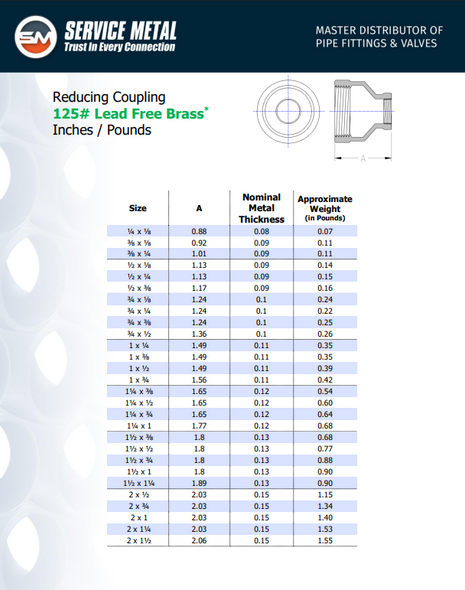
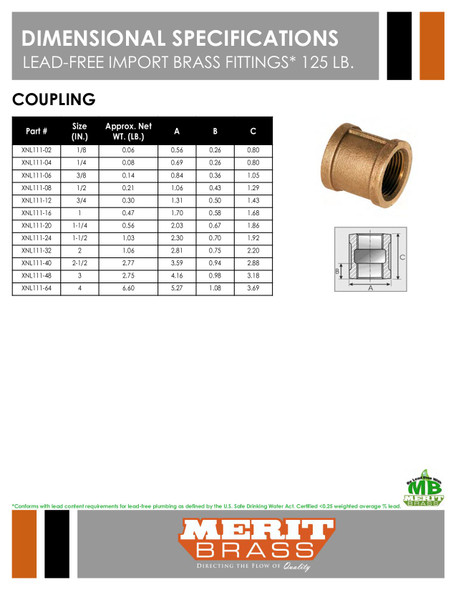
Review manufacturer dimensional information for applicable lead free brass reducing couplings and connection sizes.
Import Brass Fitting Certification Letter
Review the manufacturer certification documentation covering the lead free brass fitting product line.
Material Safety Data Sheet
Review the manufacturer material safety documentation for additional product and material information.
Need Help Selecting a Lead Free Brass Reducing Coupling?
Our industrial PVF specialists can help review your larger and smaller connection sizes, thread requirements, pressure class, application, and lead-free plumbing requirements before you order.
Frequently Asked Questions
What is a reducing coupling used for?
A reducing coupling is used to connect two compatible male-threaded piping components of different nominal sizes in a straight run.
How is a reducing coupling different from a standard coupling?
A reducing coupling connects different nominal pipe sizes, while a standard coupling typically connects matching sizes.
What pressure class is this fitting?
This fitting is identified as a 125# lead free brass reducing coupling.
Is this fitting lead free?
Yes. The supplied product information states that it conforms with lead-content requirements for lead-free plumbing as defined by the U.S. Safe Drinking Water Act.
What is the certified lead content?
The fitting is identified as containing no more than 0.25 weighted average percent lead.
What connections does this reducing coupling use?
The fitting uses female threaded connections on both ends, with each end sized for its corresponding nominal pipe size.
Why use a reducing coupling instead of a coupling and bushing?
A reducing coupling combines the straight connection and pipe size transition into one fitting, which can simplify the piping layout and reduce the number of threaded joints.
Can this fitting be used in potable-water systems?
The supplied product information states that the fitting conforms with U.S. Safe Drinking Water Act lead-content requirements for lead-free plumbing. Confirm all applicable local plumbing-code and system requirements before installation.
Where can I find fitting dimensions?
Use the Import Brass Fitting Dimensions document in the Product Documents section above.
Where can I verify the lead-free certification?
Use the Import Brass Fitting Certification Letter provided in the Product Documents section above.
Is material safety information available?
Yes. A manufacturer Material Safety Data Sheet is provided in the Product Documents section above.
Important Ordering Notes
- Product is a 125# lead free brass reducing coupling.
- Designed to connect two different nominal pipe sizes in a straight run.
- Female x female threaded reducing configuration.
- Conforms with lead-content requirements for lead-free plumbing as defined by the U.S. Safe Drinking Water Act.
- Certified ≤0.25 weighted average % lead.
- Confirm both nominal connection sizes before ordering.
- Verify which end requires the larger and smaller connection.
- Verify thread compatibility with both mating piping components.
- Confirm pressure, temperature, and media compatibility before use.
- Review applicable plumbing-code requirements for potable-water installations.
- Refer to the manufacturer dimensional, certification, and material safety documents for additional product information.